
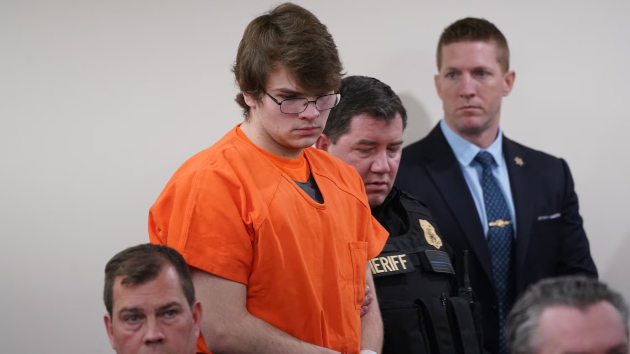
(BUFFALO, N.Y.) — More than four years after he gunned down 10 Black people in a racially motivated mass shooting at a Buffalo, New York, supermarket, Payton Gendron’s federal trial reaches a crucial point on Monday in selecting a jury that will decide whether he lives or dies.
Gendron, who will turn 23 next week, has already pleaded guilty to state charges stemming from the May 14, 2022, attack at a Tops supermarket, including domestic terrorism motivated by hate. He is serving a sentence of life in prison without the possibility of parole.
Gendron, according to his attorneys, has proposed pleading guilty to the 27-count federal indictment, including 10 counts of hate crimes resulting in death, but the Department of Justice has rejected his offer.
“The United States believes the circumstances in Counts 11-20 of the Indictment are such that, in the event of a conviction, a sentence of death is justified,” federal prosecutors said in January 2024, when they announced the decision to pursue the death penalty against Gendron.
On Monday, about 1,200 potential jurors who filled out an initial questionnaire were summoned to appear at the U.S. District Court in Buffalo to complete a more extensive inquiry to determine whether they can serve as fair and impartial jurors.
Based on their responses, Judge Lawrence J. Vilardo, who is overseeing the case, and the attorneys involved hope to whittle the potential jury pool down to several hundred.
Those who make the cut will be brought back in August to be questioned by the lawyers and judge, who are hoping to seat 12 jurors and at least six alternates for the trial scheduled to begin in October.
Gendron has pleaded not guilty to the federal charges.
Garnell Whitfield, the former Buffalo fire commissioner, whose 86-year-old mother, Ruth Whitfield, was killed in the supermarket attack, said he plans to attend Monday’s court proceedings.
Whitfield told ABC News that he’s hoping that the upcoming trial will expose those whom he says helped radicalize Gendron, including the social media companies that allegedly provided the addictive algorithms that fed Gendron’s hate of Black people.
“I’m more concerned with that than I am with him. He’s a dead man walking as far as I’m concerned,” Whitfield said.
Social media companies are not defendants in the trial, have not accused of any wrongdoing by prosecutors.
Whitfield and other relatives of those killed and wounded in the attack filed a lawsuit in May 2023 against several social media companies alleging they facilitated the teenage killer’s white supremacist radicalization by allowing racist propaganda to fester on their platforms. The outcome of the case is still pending in the state Supreme Court. The social media companies have denied all wrong doing.
During his sentencing in the state case in May 2023, Gendron apologized to the relatives of the victims, saying he was “very sorry for all the pain” he caused and “for stealing the lives of your loved ones.”
“I did a terrible thing that day,” Gendron said in court. “I shot and killed people because they were Black. Looking back now, I can’t believe I actually did it. I believed what I read online and acted out of hate. I know I can’t take it back, but I wish I could, and I don’t want anyone to be inspired by me and what I did.”
Gendron planned the massacre for months — including previously traveling twice to the Tops store he targeted, a more than three-hour drive from his home in Conklin, New York — to scout the layout and count the number of Black people present, according to state prosecutors. Wearing tactical gear, body armor and wielding an AR-15-style rifle he legally purchased and illegally modified, Gendron committed the rampage on a Saturday afternoon when prosecutors said he knew the store would be full of Black shoppers.
The attack was caught on a Tops supermarket surveillance camera and a helmet camera worn by Gendron that he used to livestream on Twitch. Before the attack, he also posted a racist screed online containing the names of past mass shooters he admired.
Brian Buckmire, an ABC News legal analyst, said Gendron’s attorneys are aiming at seating jurors who can set aside the defendant’s guilty plea and decide the case based on the facts presented at trial.
“This is not a case of guilt or innocence; this is a case … of attempting to save his life,” he said.
Buckmire said that in the current phase of jury selection, potential members of the panel will likely be asked about their personal beliefs about the death penalty.
He noted that the judge in the case has already denied a request from the defense to move the trial from Buffalo in Erie County to Rochester in Monroe County.
“So, it’s deep in the heart of where all of this harm happened,” Buckmire said.
Buckmire said the defense is facing an uphill battle and will likely focus on trying to persuade the jury that Gendron should not be put to death.
“From a fact-based standpoint, it’s hard to say he’s not guilty,” Buckmire said. “I think the only argument here and the only strength of anything they can make out here is he doesn’t deserve the death penalty because of his age [and] the influences he had.”
Copyright © 2026, ABC Audio. All rights reserved.

- Vance says Iran agreement has been digitally signed, but remains vague on its key elements - June 15, 2026
- Jury selection reaches pivotal moment in federal trial of Buffalo racist mass shooter - June 15, 2026
- Child killed after officer fires upon car following reported shoplifting at a Walmart in Mississippi: Police - June 15, 2026