
(CORPUS CHRISTI, Texas) — The criminal case against former Uvalde, Texas, school police officer Adrian Gonzales could be in jeopardy after defense attorneys accused prosecutors of withholding key information that was revealed during the first day of testimony on Tuesday.
Defense attorneys alleged prosecutors failed to disclose that a former Robb Elementary School teacher changed her original account of the shooting during testimony in the long-anticipated trial.
Judge Sid Harle excused the jury and canceled the trial for Wednesday, and instead scheduled a special hearing for Wednesday afternoon to determine how the case could proceed in the wake of Tuesday’s events. Harle offered no indication of how he might rule, though he told the court there are several possibilities after defense attorneys suggested they could ask for a mistrial.
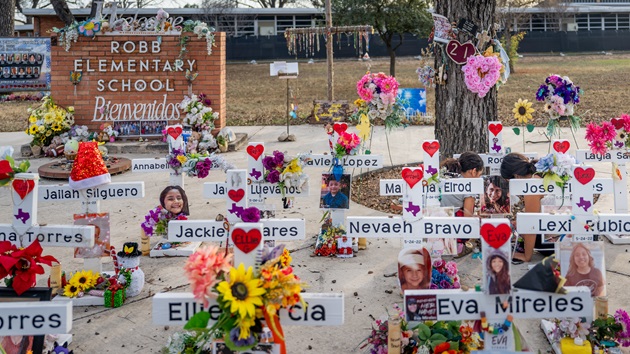
Nineteen students and two teachers were killed in the May 24, 2022, shooting at Robb. Investigations faulted the police response and suggested that a 77-minute delay in police mounting a counterassault could have contributed to the carnage that day.
Gonzales, who was one of nearly 400 law enforcement officers to respond to the scene, was charged with 29 counts of child endangerment for allegedly ignoring his training during the botched police response. Gonzales has pleaded not guilty and his legal team maintains he’s being scapegoated. This case marks the second time in U.S. history that prosecutors have sought to hold a member of law enforcement criminally accountable for their response to a mass shooting.
The legal dispute on Tuesday stemmed from the testimony of former teacher Stephanie Hale, who told jurors she saw the shooter, Salvador Ramos, firing toward her and her students near the playground.
“As we were all running into the classroom, I saw the — I don’t know if you call him — horrible person, walking,” she testified. She said she sheltered with her students in a classroom and armed themselves with safety scissors.
Defense attorneys immediately objected, arguing that in an interview with state investigators four days after the shooting, Hale didn’t mention seeing the shooter or being shot at.
In a remarkable turn of events, the judge allowed defense lawyers to question District Attorney Christina Mitchell under oath in open court about the issue. Mitchell confessed that she was not aware the teacher’s testimony had changed. Prosecutors acknowledged that she mentioned seeing the shooter in interviews with investigators ahead of trial.
While witnesses sometimes change their accounts of traumatic events without casting doubt on their entire testimony, prosecutors are under a legal obligation to turn over ahead of trial notes of their meetings with witnesses, experts say. Defense lawyers argue they did not receive any notes showing the change in testimony, which, they argue, is vital to their defense.
Hale is the only witness so far who has placed the shooter on the south side of the school and in range of Gonzales.
“If she did report these things to the prosecution, we were entitled to that to prepare for this. And this is a trial by ambush,” defense attorney Jason Goss said.
Gross was pointed in his questioning of the district attorney, saying, “Neither the prosecutor nor anyone in the room thought to ask her, ‘Where did you see the shooter?'”
“You know, you’re getting very nitpicky. … When we were prepping these witnesses, I was running a law office,” Mitchell responded. “I was in and out of interviews, so I can’t say that … ‘Oh my God,’ you know, it wasn’t that type of reaction for me.”
Harle is set to decide the next steps during Wednesday afternoon’s hearing.
In an interview with reporters outside court on Tuesday, lead defense attorney Nico LaHood declined to say whether he would ask for a mistrial, though he noted the option was on the table.
Local attorneys who spoke with ABC News described Hale, the judge overseeing the case, as a well-experienced jurist known for setting high standards for the lawyers who practice before him. The Texas law that requires prosecutors hand over witness statements to defense attorneys — known as the Michael Morton Act — stemmed from a case in which Harle, himself, exonerated a man wrongly accused of killing his wife.
“He’s not going to do any favors,” Gerry Goldstein, an attorney for Morton, said of Harle. “He will call orders as he sees them.”
Copyright © 2026, ABC Audio. All rights reserved.