
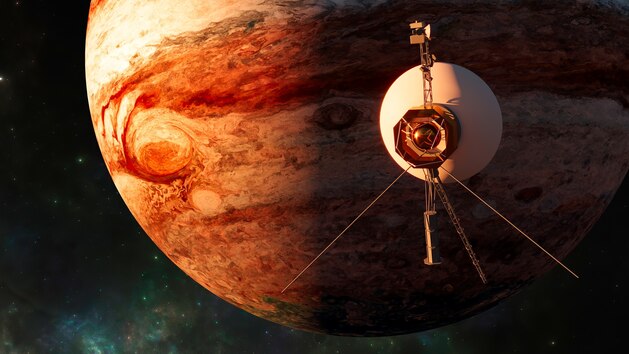
In 1977, NASA launched Voyager 1, a robotic space probe built to explore the farthest reaches of our solar system. It was supposed to be a 5-year mission.
Nearly 50 years later, it’s still going.
On Wednesday at 5:16 a.m. ET, the spacecraft will be one light-day, the distance light travels in 24 hours, from Earth. More than 16 billion miles away from home and traveling 38,000 mph, it will be the first human-made object to reach one light-day away from our planet.
“It’s just a real testament to what humans can build, and it’s truly breaking new ground every second as it progresses further and further into interstellar space,” Casey Dreier, The Planetary Society’s chief of space policy, told ABC News. “This is the furthest out that any human thing has been sent that is still talking to us. That is just truly remarkable.”
If you search for photos of Jupiter, Saturn, Neptune or Uranus, there’s a good bet the image was taken by Voyager 1 or its sibling spacecraft, Voyager 2. And while the data collected by the probe’s nearly dozen scientific instruments have kept scientists busy for decades, Voyager’s greatest legacy is arguably the imagery that exposed millions of people to the beauty and mystery of our solar system for the first time.
“This was full-color, beautiful, glossy photos that suddenly made these points of light into real worlds and real systems,” said Dreier. “It told us how much we didn’t know about the solar system in which we inhabit, and it is hard to overstate the contributions of the two Voyager spacecraft to our understanding of where we live in space.”
Although Voyager 1 launched after Voyager 2, its faster route allowed it to overtake its twin shortly after it left Earth. It reached Jupiter in 1979 and made one of its first discoveries: a faint ring system around the planet. While two other probes, Pioneer 10 and 11, had previously flown past the planet, their imaging abilities were extremely limited. Voyager’s camera captured the planet in a way never seen before, showing a turbulent atmosphere and taking a picture every 96 seconds during its approach, which NASA used to create a time-lapse movie of the planet in motion.
In 1980, Voyager arrived at Saturn and found five new moons and a new ring. Once again, the probe sent back stunning images of the planet and six of its moons, providing evidence that those moons are largely made up of water ice. Images and data from Titan, one of Saturn’s most interesting moons, showed it has a thick atmosphere composed mostly of nitrogen, with methane and hydrocarbons. This chemical soup may resemble what Earth was like billions of years ago. NASA’s Dragonfly rotorcraft is slated to launch to Titan in 2028 to study its habitability.
In 1990, Voyager 1 took the famous pale blue dot photo of Earth from a distance of 3.7 billion miles, at the suggestion of astronomer Carl Sagan, who later named one of his books after it. At the same time, Voyager also took a “family portrait” of six of our solar system’s planets.
Now traveling in interstellar space, a vast, empty region between star systems, Voyager 1 still transmits information back to Earth, which will now take 24 hours to reach its destination. NASA briefly lost communications with the vehicle in Oct., but it came back 48 hours later. The agency has also shut down several instruments over the years to save power.
Eventually, Voyager’s plutonium power source will die, but physics will keep it moving through deep space. And since there’s not much there to impede its progress, it could keep going long after we are gone.
But our species’ fingerprints will remain with Voyager in the form of a nearly 12-inch gold-plated copper disk inscribed with Earth’s location relative to several pulsars. The playable record contains greetings in 55 languages, audio clips of human and animal sounds, 90 minutes of music from different periods and images of life on our planet.
“It carries a little testament to the humans and the world that made it. That billions of years from now, when our planet is engulfed by the Sun and everything on this world no longer exists. Voyager will still exist, and it’ll carry a little signature of gold written in gold of this planet and its humans,” explained Dreier.
Copyright © 2026, ABC Audio. All rights reserved.

- Timeline of the FAA nationwide ground stop: How it developed - November 16, 2026
- Huge waves slam West Coast as storms continue - November 16, 2026
- Officials investigating steering of tanker in New Orleans riverboat collision: NTSB - November 16, 2026