
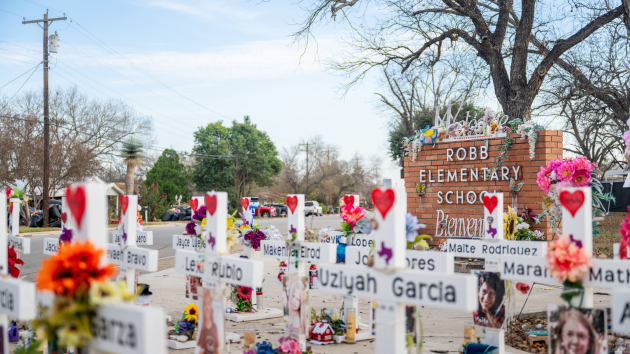
(UVALDE, Texas) — A jury has acquitted former Uvalde, Texas, school police officer Adrian Gonzales for his response to the Robb Elementary shooting in May 2022.
After more than seven hours of deliberations, the jury returned a not guilty verdict Wednesday evening on all 29 counts of child endangerment.
As the verdict was read, Gonzalez bowed his head as he heard it. Several of those sitting in the gallery started crying. He hugged his lawyers, shook hands and appeared to be tearing up.
Gonzales was among the first officers to respond to the mass shooting, in which 19 students and two teachers were killed. It took 77 minutes before law enforcement mounted a counterassault to end the rampage.
Prosecutors alleged Gonzales did not follow his training and endangered the 19 students who died and an additional 10 surviving students.
Lawyers for Gonzales, who pleaded not guilty, argued he was unfairly blamed for a broader law-enforcement failure that day.
Ex-officer: Focused on ‘picking up the pieces’
When he walked out of the courtroom on Wednesday night after the jury acquitted him, Gonzales was a man of few words.
“I want to start by thanking God for this — my family, my wife and these guys — he put them in my path,” he told reporters, referring to his lawyers. “Thank you for the jury, for considering all the evidence.”
When ABC News’ John Quiñones asked him, “What does moving on look like to you?” he answered succinctly.
“Picking up the pieces and moving forward,” Gonzales said.
Asked about the frustration of some of the families of victims about the verdict, defense attorney Nico LaHood said he’s “sorry that they feel that way” and vowed to pray for them.
“We pray for them. We’re sorry that they feel that way. We understand that their separation from their loved one is going to be felt as long as they walk on this earth, and we don’t, we don’t ignore that. We acknowledge that we’re just going to continue to pray for them. So I’m very sorry that they feel that way,” he said.
According to LaHood — who said he spoke with some of the jurors after the verdict — the jury was saddened by the trial but couldn’t see through some gaps in the prosecution’s case.
“They were very mindful and deliberate,” LaHood said. “Obviously, they were saddened, because they know what the other families are mourning still, but they said there were a lot of gaps in the evidence, and some of it didn’t make sense.”
Jason Goss, another attorney for Gonzales, told reporters that he believes the verdict clears his client’s name.
“The evidence showed that not only did he not fail, but he put himself in great danger,” Goss said. “So, you can imagine how somebody who has had the entire country look at him as somebody who was not willing to do his duty. He is a proud man who does do his duty. And he went in there. When it was time for him to go, he went in there.”
Families of the victims react
For Jacinto Cazares — whose 9-year-old daughter Jackie died in the shooting — the verdict was yet another instance of the legal system failing to deliver justice after one of the worst mass shootings in US history.
“We had a little hope, but it wasn’t enough,” he said outside the court. “Again, we are failed. I don’t even know what to say.”
Cazares said he was hopeful that the jury might have reached a different conclusion but “prepared for the worst.”
“I need to keep composed for my daughter. It has been an emotional roller coaster since day one. I am pissed,” he said.
Jesse Rizo, Jackie’s uncle, told reporters he was concerned about the message the verdict might send to police officers who respond to future mass shootings.
“I respect the jury’s decision, but what message does it send?” he said. “If you’re an officer, you can simply stand by, stand down, stand idle, and not do anything and wait for everybody to be executed, killed, slaughtered, massacred.”
When asked about the defense case by ABC’s John Quiñones, Jackie’s aunt Julissa Rizo pushed back on the defense narrative that Gonzales acted heroically that day.
“The defense said he did as much as he could,” Quiñones said.
“That’s not true,” she responded. “There were two monsters on May 24. One was the shooter, and the other one was the one that never went in, that could have avoided this.”
How the trial unfolded
Each of the 29 counts Gonzales faced carried a maximum penalty of two years in prison, and h. could have spent the rest of his life in prison if he was convicted.
Prosecutors claimed Gonzales had a unique opportunity to stop the carnage when he arrived and learned gunman Salvador Ramos’ location from a teaching aide. The aide testified that she repeatedly urged Gonzales to intervene, but said the officer did “nothing” in those crucial moments. Prosecutors also argued Gonzales failed to act once he got inside the school.
Before jurors were sent to deliberate, District Attorney Christina Mitchell gave an impassioned plea, saying, “I know this case is difficult, and it has been difficult. But we cannot continue to let children die in vain.”
The defense argued that Gonzales did everything he could in that moment — including gathering critical information, evacuating children and entering the school — and said Gonzales acted on the information he had. The defense also highlighted that other officers arrived in the same timeframe as Gonzales and that at least one officer had an opportunity to shoot the gunman before he entered the school.
This case marks the second time in U.S. history that prosecutors have sought to hold a member of law enforcement criminally accountable for their response to a mass shooting.
In 2023, a Florida jury acquitted Scot Peterson, a former Broward County sheriff’s deputy, who was charged with child neglect and culpable negligence for his alleged inaction during the 2018 shooting at Marjory Stoneman Douglas High School in Parkland, Florida. Peterson’s lawyers argued his role as an armed school resource officer did not amount to a caregiving post needed to prove child neglect in Florida, and that the response to the shooting was muddled by poor communication.
Former Uvalde Schools Police Chief Pete Arredondo — who was the on-site commander on the day of the Robb Elementary shooting — is also charged with endangerment or abandonment of a child and has pleaded not guilty. Arredondo’s case has been delayed indefinitely by an ongoing federal lawsuit filed after the U.S. Border Patrol refused repeated efforts by Uvalde prosecutors to interview Border Patrol agents who responded to the shooting, including two who were in the tactical unit responsible for killing the gunman at the school.
“What happened to Uvalde on May 24 can happen anywhere, at any time,” she said. “If it’s going to happen, and if we have laws mandating what the responsibility of a law enforcement peace officer is for a school district, then we better be ready to back it up.”
Copyright © 2026, ABC Audio. All rights reserved.