
(NEW YORK) — Several regions in the West could be facing worsening drought conditions, increased wildfire risk, and reduced water supplies due to record-breaking temperatures and minimal winter snowpack.
Much of the West has been coping with prolonged drought conditions that are now being worsened by historically low seasonal snowpack and persistent record-breaking temperatures. With mountain snowpack sharply reduced, the region’s water supplies are facing mounting challenges and elevated wildfire risk is occurring earlier than usual.
More than half of the West continues to experience drought conditions of varying intensity, according to the U.S. Drought Monitor. The ongoing drought was compounded by the region’s warmest winter on record, according to the National Oceanic and Atmospheric Administration (NOAA).
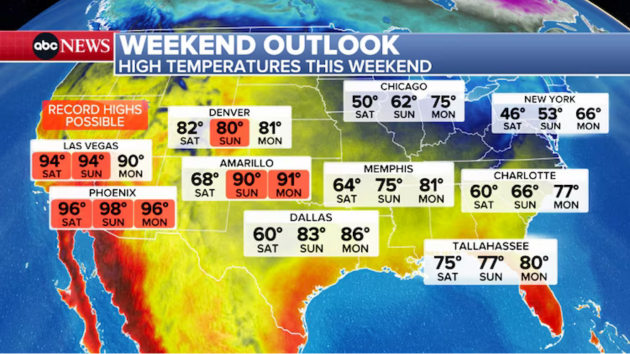
The drought and record-warm winter were followed by unprecedented, record-breaking heat in March, further intensifying conditions across the region.
Rounds of rain and mountain snow are expected to impact parts of the West in the coming weeks.
However, a full recovery is unlikely in the near term, meaning many detrimental impacts could persist, or even intensify, through the rest of the year. However, the long-term outlook remains uncertain, with the strength of the upcoming monsoon season and the potential development of El Niño and other influential factors.
Record low snowpack
Every major river basin and state in the West is experiencing a snow drought, a period of abnormally little snowpack for the time of year, according to NOAA.
The snow drought has significantly worsened in recent weeks following the unprecedented record-breaking March heat in the region. Snowpack is a significant indicator of drought conditions but not the only one.
Many major river basins, including the Colorado River Basin, are experiencing record-low season-to-date snowpack levels. A key metric in assessing these conditions is snow water equivalent, the amount of water contained within the snowpack. It serves as a critical indicator of the West’s water supply, helping determine how much runoff will flow into rivers and reservoirs during the spring melt.
When there is a snow drought in the West, it means “there will be a lack of available water due to the low snowpack to meet the water supply demands of the critical economic sectors we have,” Jason Gerlich, regional drought early warning system coordinator for the NOAA-National Integrated Drought Information System, told ABC News.
While many areas received average or above-average precipitation in the fall and early winter, warmer temperatures led much of it to fall as rain rather than snow, resulting in unusually low snowpack, which typically acts as a natural reservoir.
“If winter precipitation is falling as rain instead of snow, our relationship with water in the West becomes even shakier,” said Casey Olson, a climate scientist with the Utah Climate Center. “A gallon of winter rain that immediately runs off downstream is not nearly as helpful come July as a gallon of snowpack that melts in April or May. They are not equivalent gallons of precipitation in terms of our ability to use them when we need them the most.”
Snowpack across the western United States typically peaks in late March or early April, marking a critical point in the region’s water supply outlook. While additional mountain snowfall remains possible through April, and in some higher elevations, into May, recovery to normal snowpack is not climatologically possible at this point, Gerlich noted.
Drought on its own already stresses water supplies, agriculture, and ecosystems. But when winter fails to deliver significant mountain snow, those impacts can intensify. In some states, up to about 75 percent of water supplies can come from melting snow, according to the USGS.
Mounting water supply concerns
The Colorado River provides water for more than 40 million people and fuels hydropower resources in seven states: California, Arizona, Nevada, Colorado, New Mexico, Utah and Wyoming, according to the U.S. Bureau of Reclamation. Major reservoirs in the Colorado River Basin remain well below average, the agency’s latest data shows, heightening concerns about water availability across the region.
Lake Powell, the second largest reservoir in the United States, is one of them. Water levels have dropped roughly 7 feet so far this year and are forecast to continue a gradual decline through the months ahead. Despite the recent drop, the reservoir remains more than 8 feet above its record low set in April 2023.
However, current projections suggest that level could be approached, or even challenged again, by late summer if dry conditions persist.
Denver Water, the city’s public water utility, announced water restrictions for the first time since 2013 on Wednesday, seeking a 20% reduction in water use.
“The snowpack within Denver Water’s collection system has deteriorated significantly and continues to decline,” said Nathan Elder, Denver Water’s manager of water supply. “Snowpack levels in both basins are now the lowest observed in the past 40 years, with accelerated melting underway.”
Experts warn that restrictions are likely to expand in multiple states as the year progresses, barring significant changes.
Wildfire concerns increase; Long-term risk remains uncertain
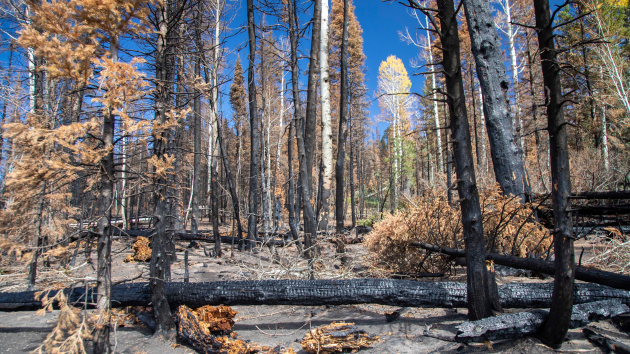
A large portion of the West will likely face an elevated wildfire risk this spring and summer driven by low snowpack, dry soils, and above-average temperatures, leaving vegetation drier and more flammable than usual.
However, experts say the long-term wildfire outlook for the region is less certain than it might seem and the risk could vary in intensity in the coming months, depending on conditions.
“Low snowpack and fire don’t have a one-to-one relationship, but low snowpack can lead to an early start to the fire season,” Gerlich said.
The record-breaking March heat further dried the landscape, priming it for wildfires earlier than usual. Parts of Colorado, Wyoming and New Mexico have already seen impactful wildfires this year. Experts say the long-term wildfire outlook hinges on how several key conditions develop over the next few months.
“One positive right now is that the last few years have resulted in limited growth of the fine fuels that are quick to burn, so that does help temper fire risk for areas in the West, however, the lack of snowpack this year presents conditions through the high timber forests where fire risk this summer could be very high,” Olson added.
The latest outlook from the National Interagency Fire Center shows an overall near-average risk of significant wildland fires across the West through May with a more widespread above-average risk unfolding across the Four Corners region, including parts of Colorado, New Mexico, Utah, and Arizona in June.
“The Southwest looks to continue with the warm and dry seasonal pattern. One source of optimism is for the possibility of an active monsoon pattern this summer,” said Olson. “An active monsoon system in general should provide some relief to portions of the Southwest states, the question remains exactly where that relief would focus, and we won’t have a good handle on that until later this spring.”
Copyright © 2026, ABC Audio. All rights reserved.

- Intensifying drought could trigger water shortages and prolonged fire season in the West - March 28, 2026
- Persistent heat and dangerous wildfire conditions could impact these parts of the US this weekend - March 28, 2026
- How police arrested a suspect in the 1990 ‘Lovers’ Lane’ cold case murders in Houston - March 27, 2026